

Registration opens for the NOC’s Marine Autonomy and Technology Showcase 2020
Registration is now open for the National Oceanography Centre’s Marine Autonomy and Technology Showcase (MATS) 2020, which will be held as a virtual event for the first time from 10–12 November.
MATS 2020 will still feature a packed three-day programme of exhibits, presentations, panel discussions and networking, offering a unique and valuable opportunity to find out about the latest developments in marine autonomous technology and how this field is set to develop in the years to come. The event also enables organisations to engage with the NOC to explore opportunities around funding, sharing ideas and getting those ideas in front of influential, high-profile users from the marine and maritime sector.
As ever, the event will welcome a broad roster of speakers from across industry, academia, and government organisations. Each day of the showcase will see leading figures from the world of marine autonomy and technology take to the virtual stage to present on innovative and disruptive technologies, as well as highlighting current developments and future priorities and challenges.
Keynote speakers
This year’s keynote speakers are Leslie-Ann McGee, Assistant Director of the Consortium For Marine Robotics at Woods Hole Oceanographic Institute, and Neil Tinmouth, Chief Operating Officer at SEA-KIT International Ltd.
As the Assistant Director for the Consortium for Marine Robotics at the Woods Hole Oceanographic Institution, Leslie-Ann is responsible for developing strategic vision and leadership, managing external relations and partnerships and retaining primary responsibility for organisational and program management of CMR.
Leslie-Ann is an expert in ocean and coastal issues in both the domestic and international arena and has a diverse background working with and for state, regional, national, business and environmental entities globally. She has successfully partnered with interest groups, industry members, private non-profits and other stakeholders to form cohesive management strategies by communicating regularly with a wide variety of stakeholders with often conflicting perspectives.
SEA-KIT International’s vision is to be a world-class provider of high technology solutions to the maritime and research industries and to open new fields and classes of technology to solve the problems of the future, today. SEA-KIT International is dedicated to working with partners and peers to create a safer and more sustainable offshore working environment.
Neil Tinmouth, Chief Operating Officer, said: “We’re delighted to have been invited to deliver the Industry keynote talk at this year’s Marine Autonomy and Technology Showcase. The Shell Ocean Discovery XPRIZE competition provided a fantastic springboard for SEA-KIT and enabled us to showcase our ground-breaking deployment of an autonomous underwater vehicle from an unmanned surface vehicle. We are looking forward to sharing our XPRIZE story, as well as the progress and achievements that have come since, with the MATS audience.”
Aidan Thorn, the NOC’s Marine Robotics Innovation Centre manager and chair of the MATS organising committee, said: “2020 is proving to be a hugely challenging and unsettling time for people around the world, and obviously it’s having a major impact on the industry events calendar here in the UK. In the light of this we have decided that moving MATS 2020 to a virtual conference format is the responsible and practical thing to do. As far as possible we will try to keep proceedings as ‘normal’ as possible, and the new format will offer opportunities to innovate and try new things.
'Pioneering work'
“MATS 2020 will still be a great showcase for the pioneering work that the NOC and its partners are delivering in the field of marine robotics, for the benefit of UK industry and the scientific community. The event has always been a celebration of emerging and existing partnerships across the industry, and a genuine catalyst for innovation in the sector, with a consistent theme of collaboration underpinning many of the discussions over the last few years. I am confident that these conversations and partnerships will continue the thrive despite the many challenges that we all face at the moment.”
Tickets are priced at £130 (including VAT) for the three-day online event, with a limited number of student places available costing £80. The full programme will be announced in the coming weeks.
Details on how to register are available at mats2020.vfairs.com


Oceans of Opportunity to be explored at Subsea Expo 2021 - How the UK’s underwater industry can capitalise on $3 trillion Blue Economy
The theme for Subsea Expo in 2021 will be Oceans of Opportunity – harnessing the Blue Economy.
The exhibition and conference will explore how the UK’s underwater engineering industry can capitalise on the global blue economy, estimated to be worth $3 trillion by 2030.
Organised by industry body, Subsea UK, the three-day event will take place at Aberdeen’s P&J Live from 23-25 February 2021.
Europe’s largest exhibition and conference focused on the underwater industry is set to be one of the first post-pandemic, large scale physical, as opposed to virtual, events back on the international calendar.
Neil Gordon, chief executive of Subsea UK, said: “The underwater engineering industry currently generates annual revenues of £7.8billion and a large slice of that still comes from the oil and gas sector. However, as the industry extends its reach into offshore wind, defence, ocean and marine science and aquaculture, there is the opportunity to grow global marketshare of what’s now known as the blue economy or ocean economy.
“Forecast to be worth around $3 trillion in the next ten years, the blue economy is the sustainable use of ocean resources for economic growth. Oil and gas, offshore and marine renewables and aquaculture account for around a third of its value.
“This is good news for the subsea industry whose underwater engineering capabilities, honed in North Sea oil and gas and increasingly in demand in offshore wind, are eminently transferrable to defence, ocean science, aquaculture and deep sea mining.”
With leading figures from all these sectors presenting at Subsea Expo 2021, the event is an ideal platform for companies to glean market intelligence, identify new opportunities and ways of exploiting these.
Approaching its 16th year, the event attracts around 200 exhibitors and almost 7,000 delegates from around the world. Over a third of the floor space has already been booked for Subsea Expo 2021.
Mr Gordon added: “Interest in next year’s event is on the increase and it’s clear there is an appetite for a return to real, rather than virtual, events. Our industry’s main sector – oil and gas – has taken a double blow with coronavirus and the collapse in commodity price but, with the race to achieve net-zero, a green recovery on the horizon, including hydrogen and CCUS, coupled with oceans of opportunity in the blue economy, we are sensing renewed optimism. This augers well for 2021 and we anticipate a more buoyant mood at next year’s Subsea Expo.”
The deadline for submitting abstracts to present at Subsea Expo is 9th October. Entries for the Subsea UK Awards will also be accepted up to this date. Details about the award categories, booking exhibition space and sponsorship opportunities are available on the Subsea Expo website: www.subseaexpo.com

Saab Seaeye Leopards join Ocean Infinity robot fleet
Ocean Infinity have selected the Saab Seaeye Leopard to complement its pioneering 'Armada' fleet of unmanned surface robot vessels.
The Leopard work-class underwater vehicles will be deployed from Ocean Infinity’s initial 13 environmentally sustainable unmanned vessels for a variety of offshore and coastal services.
Dan Hook, Ocean Infinity, said, "The 3000 m Seaeye Leopard was chosen not only because it is well suited to USV applications but more specifically because of its comparable capabilities to a conventional hydraulic work class vehicle, but with considerably less input power, meaning materially reduced carbon emissions."
"The Leopard has ready adaptability for ‘Over the Horizon’ operations as well as a clear reputation for reliability and its suitability for remote operations – crucial for maintenance or repairs as part of an unmanned fleet," he continued.
Jon Robertson, Saab Seaeye said: "We're proud to be chosen to be part of this revolutionary unmanned fleet. The Armada Fleet complete with the Leopard vehicle will dramatically reduce the impact of offshore operations by cutting CO2 emissions and at the same time increase safety at sea by reducing manpower deployed."
Ocean Infinity’s Armada Fleet is a major advance in the global maritime industry, driving technology and sustainability to deliver a wide range of services including offshore and coastal survey data acquisition, geotechnical surveys, ROV and AUV operations, logistics and security in the safest, lowest impact and highest value way that exists today.
The fleet will be operated and monitored from onshore control centres based in Southampton UK, Austin Texas USA and a location soon to be finalised in Asia.
Construction of the fleet is underway and is expected to be operational early next year.
Find out more on the websitewww.saabseaeye.com/news

Vallourec, FORSSEA Robotics and iXblue join forces to facilitate the inspection of subsea pipelines using drones and digital technology
Vallourec, a leader in premium tubular solutions, is working with FORSSEA Robotics, a startup specializing in smart robotics and visual positioning, and iXblue, a company recognized for its expertise in inertial navigation, subsea positioning and autonomous technologies – to develop a pipeline inspection solution combining subsea drones and the use of visual markers, removing the need for surface vessels.
Traditionally, the inspection of subsea pipelines and structures requires the use of a surface vessel (manned or unmanned) with acoustic positioning used to monitor the deployment of Autonomous Underwater Vehicles (AUVs) or Remotely Operated Vehicles (ROVs). These subsea vehicles then collect the required information – such as a pipeline’s general aspect and route, anode consumption, free span, burial and crossing areas – using observation sensors.
In order to reduce pipeline inspection operational costs, Vallourec, iXblue and FORSSEA decided to develop a solution using visual markers directly integrated on subsea pipelines that enables vessel-free subsea navigation.
The project relies on barcodes placed on installed pipes, resulting in many passive positioning references logged with their own coordinates during the laying operation which will remain accessible throughout the life of the field. These markers would be used as navigation aids for subsea drones equipped with FORSEEA cameras and iXblue’s inertial navigation systems that easily relay the pipelines’ locations to the operators thus removing the need for acoustic positioning systems and costly mother vessels. To remain visible to divers and subsea drones throughout the project’s lifespan, these markers are long-term resistant to marine growth and erosion.
“This technology had already proven itself on large structures in the field”, said JeanGuillaume Besse, Vallourec R&D project leader. “Back in January of this year, we did a first sea trial on much smaller surfaces – down to pipes of 6” in diameter – in the South of France. The tests were a success, proving that these markers, combined with iXblue’s and FORSSEA’s expertise, can be used to provide accurate subsea positioning without the need of acoustic systems".
This innovative inspection technology could be further enhanced when combined with existing digital solutions from Vallourec smart’s services portfolio. For example, the Smartengo Best Fit digital solution already associates a unique tag on each pipe to ease traceability, fit-up and pipeline construction.
The advanced solution developed with FORSSEA and iXblue is a key milestone for future pipeline inspection and could be considered as a next step in the Vallourec smart offering, further facilitating operators’ asset management.
Find out more information via www.ixblue.com

Valeport gets on board with the Mayflower Autonomous Ship project
The Mayflower Autonomous Ship which is set to self-navigate across the Atlantic autonomously in Spring 2021, will be fitted with the new Valeport uvSVX and a Valeport Altimeter to provide vital precise underwater depth data which will help protect the vessel and the onboard technology on its epic journey.
Sailing from Plymouth, UK, to Plymouth, USA, the Mayflower Autonomous Ship (MAS) will trace the route of the original 1620 Mayflower to commemorate the 400th anniversary of the famous voyage. With no human captain or crew, it will become one of the first full-sized, fully autonomous vessels to cross the Atlantic.
Marine research organisation, ProMare is leading the development of the MAS. Throughout the 3220-mile journey the MAS will function as a science laboratory and Valeport’s uvSVX and VA500 Altimeter will be used to enhance the operational capability of the MAS. The MAS will also be one of the first applications for Valeport’s new compact and lightweight SVP profiler, the uvSVX. Fitted through the hull of the MAS the uvSVX features Valeport’s Sound Velocity, Temperature and Depth technology and delivers salinity, conductivity and density data, along with SVP as standard. The new uvSVX has been designed specifically for vehicles where space is a premium and high accuracy is assured with the addition of Valeport’s interchangeable pressure module that allows users to maximise operational specific depth requirements.
Powered by hybrid wind, solar and diesel propulsion system, the MAS vessel will carry research pods for sensors and scientific instrumentation. Scientists coordinated by ProMare, with support from IBM, will use the data from the research pods to advance understanding in several areas including: maritime cybersecurity, marine mammal monitoring, sea level mapping and ocean plastics.
Valeport’s instruments are ideally suited for deep ocean applications. The compact and robust Valeport uvSVX and VA500 Altimeter have state of the art signal processing technology which provides stable, repeatable readings that deliver high accuracy data performance.
MAS project director, Brett Phaneuf commented: ‘We’ve worked with Valeport for many years, integrating their equipment onto our marine vehicles, and when it comes to the Mayflower Autonomous Ship, we prise reliability, precision, low power and exemplary data above all else, and the uvSVX and VA500 Altimeter provide exactly what we need to safely navigate and enable great science at sea.’
The original Mayflower travelled at a maximum speed of around 2.5 knots and took more than two months to reach its destination, landing in Plymouth Massachusetts on 21 December 1620. The modern, upgraded autonomous Mayflower travels at up to 15 knots and should arrive in less than two weeks.
Valeport’s Head of Sales, Kevin Edwards added: “With sensor technology guiding the MAS decision making, this is an exciting demonstration of autonomous seafaring technology and we are immensely proud that our instruments are involved in the project.”
Valeport has supplied the subsea sector for more than 50 years and continues to innovate and lead the way in the design and manufacture of precision instrumentation for the hydrographic and oceanographic communities.
For more information, visit www.mas400.com and www.valeport.co.uk
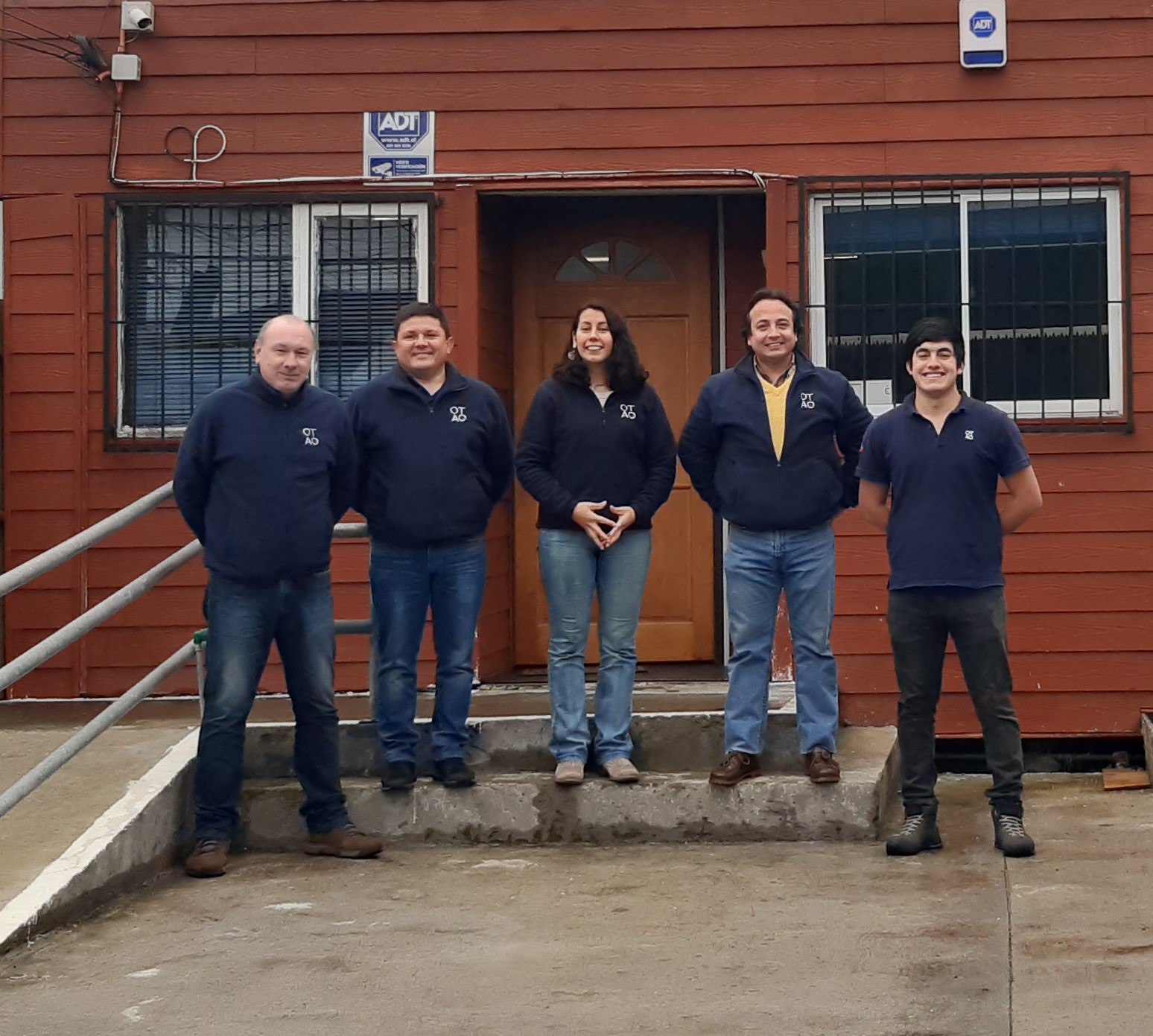
OTAQ expands Chile office to accommodate growth
World class underwater company, OTAQ Group, recently announced their Chile division has acquired a larger office space following a number of project wins, also resulting in the creation of several new positions.
The 100m2 office space, three times the size of the previous office, will accommodate the team of five, an increase from a headcount of two in just 12 months. Future team growth throughout the remainder of 2020 is also expected as OTAQ continue their drive for growth, developing their range of marine technology products.
OTAQ’s specialist product range is ideally suited to specialist Chilean sectors, especially mining and oil and gas. The highly innovative company first opened its Chile base in July 2016, providing services in Agriculture, specifically SealFENCE and SealFENCE portable, with plans to introduce the wider range of standard OTAQ products to the Chilean market.
Phil Newby, Chief Executive Officer, OTAQ Group, said: “Having established the OTAQ name and our products in Chile, we’re delighted to be moving into a bigger space which will allow us to expand our capabilities. The move to larger premises now sets the stage for us to establish a full-service offering in Chile over the coming years.”
OTAQ Group’s Chief Operations Officer, Steve Burns who head up the Chile office, said: “This is fantastic news for the group and shows our continued commitment and confidence in the region. Our team in Puerto Montt have done a truly excellent job getting the new facility up and running so quickly.”
Offering world class technology for aquaculture, OTAQ has 36 staff members across the four worldwide locations; Puerto Montt in Chile and Lancaster, Aberdeen and Ulverston in the UK.
Find out more on the website otaq.com

Dr Edie Widder to receive inaugural Captain Don Walsh Award for ocean exploration from the Marine Technology Society and the Society for Underwater Technology
Dr Edie Widder to receive inaugural Captain Don Walsh Award for ocean exploration from the Marine Technology Society and the Society for Underwater Technology - recognising her outstanding, sustained, international contribution to the development, application, and propagation of marine technology toward the advancement of ocean exploration.
The Marine Technology Society and The Society for Underwater Technology have announced that Dr. Edie Widder is the inaugural recipient of the Captain Don Walsh Award for Ocean Exploration. Dr. Widder is an MTS member, MacArthur Fellow, a deep-sea explorer, and conservationist who combines expertise in oceanographic research and technological innovation with a commitment to reversing the worldwide trend of marine ecosystem degradation.
Awarded jointly by the Marine Technology Society and the Society for Underwater Technology, this esteemed award is named after American oceanographer, explorer, retired naval officer, and marine policy specialist Captain Don Walsh. Walsh and co-pilot Jacques Piccard were aboard the bathyscaph Trieste when it made its daunting record descent on January 23, 1960 into the deepest point of the world’s oceans – the Challenger Deep in the Mariana Trench. The award recognizes outstanding, sustained, international contribution to the development, application, and propagation of marine technology toward the advancement of ocean exploration.
“Don Walsh is one of my superheroes – right up there with Marie Curie, Jacques Cousteau, and my mother – so to be the recipient of this first ever Don Walsh Award for Ocean Exploration is a huge deal,” said Dr. Widder. “I’m incredibly grateful to MTS and SUT for this honor and for all that they do to promote the development of tools for exploring the least explored regions of our ocean planet.”
A specialist in bioluminescence (the light chemically produced by many ocean organisms), Dr. Widder has been a leader in helping to design and invent new submersible instrumentation, and equipment to enable unobtrusive deep-sea observations. Working with engineers, she has conceived of and built several unique devices that enable humans to see beneath the waves in new ways, including HIDEX, a bathyphotometer which is the U.S. Navy standard for measuring bioluminescence in the ocean; important information for keeping submarines hidden from above. Dr. Widder also built LoLAR, an ultrasensitive deep-sea light meter that measures light in the deep ocean, both dim down-welling sunlight and bioluminescence - both important determinants of animal distribution patterns. She helped found the Ocean Research & Conservation Association in 2005 - an organization dedicated to the study and protection of marine ecosystems, and the species they sustain through development of innovative technologies, science-based conservation action, and public education. In the summer of 2012 Dr. Widder, along with several other scientists, filmed the giant squid in its natural habitat for the first time ever. The historic footage aired on Curiosity on the Discovery Channel in January of 2013. Her innovative work earned her the 2018 Explorers Club Citation of Merit; she became one of just six women to earn this honor.
“MTS couldn’t be prouder to bestow the inaugural Captain Don Walsh Award For Ocean Exploration upon Dr. Edie Widder,” said Marine Technology President Zdenka Willis. “From helping to devise cutting-edge marine technologies to logging hundreds of hours exploring the depths aboard deep sea submersibles to sharing her discoveries with her peers and the global community alike, Dr. Widder is well deserving of an award named for one of the foremost pioneers in our field. We are honored to count her as a colleague and cannot wait to see where her expertise takes her next.”
“As well as recognizing outstanding individual achievement, a key objective of the Captain Don Walsh Award is to spotlight role models who will inspire early career marine technologists, scientists and engineers” said Society for Underwater Technology President Ralph Rayner. “Edie Widder is a perfect exemplar of what young members of our community can aspire to. She and Don Walsh provide an inspiration to us all.”
To find out more visit www.mtsociety.org

Novacavi for floating solar power plant system
The Novacavi team were recently asked to develop and manufacture a prototype of a rugged and reliable custom-engineered cable solution for an innovative floating solar electricity system for marine environment installed in Oslo fjord, Norway.
Being challenged by its specific permanent application on top of floating fully supported solar panels above water level, Novacavi managed to engineer a water blocked composite power and signal cable with polyurethane outer sheath to ensure maximum performance without losing elasticity in constant cold climates, water splashing or submersion and sun exposure.
“Proud to apply our technical and manufacturing expertise and deliver our cable as a relevant component of this innovative floating solar power plant system with high energy production capacity and limited environmental impact”, said Francesca Faverio, business development manager, Novacavi.
As a specialist in custom cable design & manufacturing for advanced technology since 1975, Novacavi develops any cable solutions with engineering expertise, comprehensive knowledge of materials and a high degree of manufacturing.
For more details, please contact [email protected] or visit www.novacavi.it/news

Applied Acoustics launches Pyxis Integrated Inertial USBL System - The new normal in subsea positioning
Applied Acoustic Engineering (AAE) has announced the launch of their next generation USBL system, Pyxis USBL. Taking its name from the constellation Pyxis Nautica - the mariner’s compass - Pyxis USBL takes the best of AAE’s subsea acoustic tracking technology with a highly advanced inertial navigation system (INS) from one of the most respected names in the industry, to create a state of the art, inertially aided Ultra Short Baseline system capable of accurate subsea tracking with survey grade performance.
The combination of AAE’s Sigma 2 acoustic protocols and SBG Systems high precision Navsight Apogee Marine INS brings together two leading names in the field of marine technology, resulting in AAE’s most accurate and long range positioning system to date, and in the process providing many time, cost and performance benefits to global survey operators.
As a tightly coupled, factory fitted package, Pyxis USBL is a portable, calibration free system able to immediately operate from any vessel as soon as the work site has been reached. The MEMS based INS does not fall under ITAR regulations, and the range restricted option means the whole system can be shipped unhindered and without export control to almost anywhere in the world. A feature of the Pyxis system is the ability for the operator to deactivate the range restriction in the field under an export-controlled regime.
A spokesperson for SBG Systems commented “AAE and SBG Systems have collaborated for several years on different projects and have established an excellent relationship. We are thrilled that Applied Acoustics has selected our Navsight Apogee OEM high performance system to be integrated into the first-ever USBL to embed a MEMS INS”.
Available with short range omni-directional or long range directional transceiver options, the versatility of Pyxis USBL makes it ideal for very shallow operations such as diver monitoring, for deeper applications where ROV’s and AUV’s might be deployed, and for tracking short or long range towed sensors such as magnetometers and side scan sonars.
Applied Acoustic Engineering is an independent designer and manufacturer of highly regarded subsea electronic-acoustic products, and a founding member of the AAE Technologies group of companies. Founded in 1989, the company has an established international client base covering many industry sectors, backed up by overseas offices and service centres and supported by a dedicated global distributor network.
To watch the launch animation visit their YouTube channel.
Teledyne CARIS AI software onboard successful UTAS USV mission
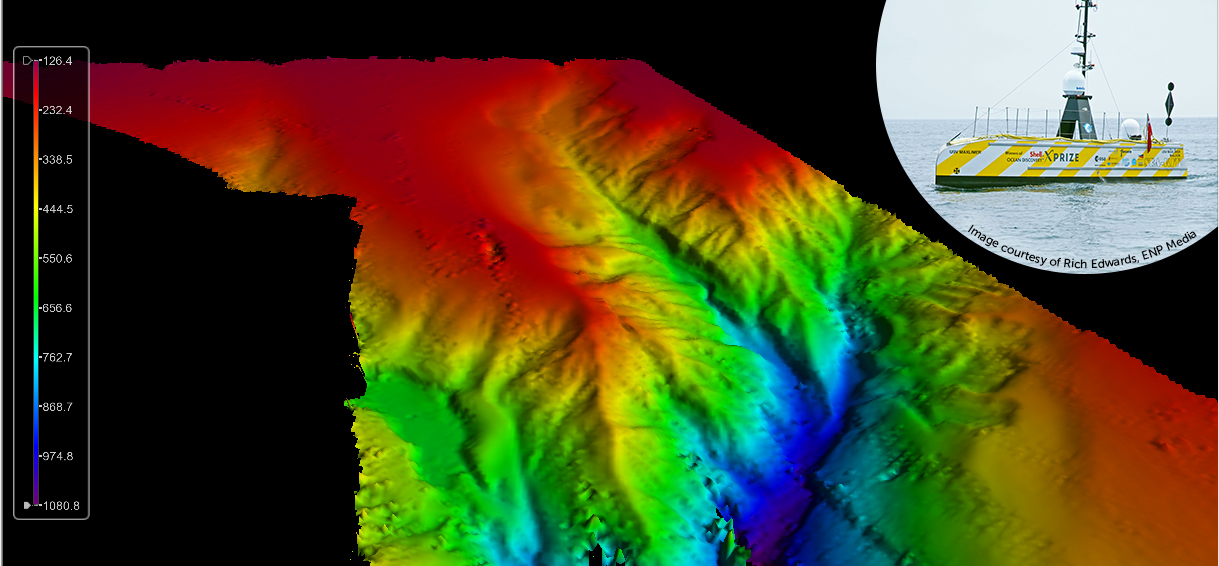
Teledyne CARIS, a Teledyne Technologies [NYSE:TDY] company, was an integral part of the illustrious team involved in the ground-breaking uncrewed offshore survey mission in the Atlantic Ocean. Teledyne CARIS’ Mira AI and CARIS Onboard software were present on the vessel to enable autonomous survey and real-time processing operations. The mission’s Uncrewed Surface Vehicle (USV) built by SEA-KIT mapped over 1000 sq kms of the ocean floor in 22 days, while being continuously monitored via satellite communications at its Remote Operations Center in Essex, United Kingdom. A specialized team comprised of the GEBCO-Nippon Foundation Alumni Team operated the survey equipment and provided quality control of the data from various ‘work-from-home locations’ around the world.
The SEA-KIT USV surveyed a predominately unsurveyed area at the southwestern edge of the UK Continental shelf. The image displays the initial results following a fully automated processing workflow. Final processing is currently being completed using CARIS HIPS software to produce the final deliverable for the survey.
The success of the Teledyne CARIS tools in the UTAS project demonstrates its software capabilities to support uncrewed surveys in the future and the crucial role it will play in The Nippon Foundation-GEBCO Seabed 2030 project. Seabed 2030 is an ambitious effort between GEBCO and The Nippon Foundation to complete the global mapping of the ocean floors in the next 10 years.
“Teledyne CARIS is uniquely positioned to underpin Seabed 2030 goals through its AI capabilities, web services and automated data processing workflows,” said Andy Hoggarth, VP, Sales and Marketing at Teledyne CARIS.
“The success of this first leg is a tribute to the strong leadership of SEA-KIT and the unique capabilities and insights of all of the member organizations–̶ we are delighted to play a part in this mission.”
Teledyne CARIS is part of the Teledyne Imaging group. For 40 years, Teledyne CARIS has been the leading developer of marine mapping software. We offer a highly effective solution for near real-time processing, robust quality control of sonar data, and the creation and distribution of maps, charts, and digital datasets.
Teledyne Imaging is a group of leading-edge companies aligned under the Teledyne umbrella. Teledyne Imaging forms an unrivalled collective of expertise across the spectrum with decades of experience. Individually, each company offers best-in-class solutions. Together, they combine and leverage each other’s strengths to provide the deepest, widest imaging and related technology portfolio in the world. From aerospace through industrial inspection, scientific research, spectroscopy, radiography and radiotherapy, geospatial surveying, and advanced MEMS and semiconductor solutions, Teledyne Imaging offers worldwide customer support and the technical expertise to handle the toughest tasks. Their tools, technologies, and vision solutions are built to deliver to their customers a unique and competitive advantage.
For more information, contact
Jennifer Parham, Marketing Manager, Geospatial
Teledyne CARIS
+1 905 660 0808
[email protected]