

Impact Subsea is recruiting a Technical Sales Engineer
Reporting Line
The Technical Sales Engineer will report directly to the Managing Director.
Location
Primarily based at Impact Subsea headquarters, Ellon, Aberdeenshire.
There will be a requirement to visit customers, conferences, exhibitions and other work locations as required globally.
Role
To apply your technical knowledge along with sales skills to generate and develop new sales leads.
Key Responsibilities
The Technical Sales Engineer will be required to:
• Prepare proposals & quotations.
• Provide pre and post-sale customer support.
• Organise sales visits to new and existing customers.
• Create sales literature (brochures, website content, social media content etc).
• Attend trade exhibitions, conferences and meetings within the UK and globally.
• Assist with the management and growth of the distributor network.
• Work with sales team to ensure sales targets are met.
Key Outcomes
• To increase sales in-line with the company sales plan.
• To assist with the day to day management of customers and enquiries.
• To assist with the growth of the company’s distributor network.
Limits of Authority
Full responsibility for all operational activities within the philosophies and constraints laid out in the job description.
The company reserves the right to change the activities listed, taking into account the job holder's qualifications and experience to enable the business needs to be met.
Qualifications & Experience
Essential:
• Degree qualification in relevant discipline.
• Experience in a customer facing role.
• Strong technical skills.
• Experience in sales.
Desirable:
• Experience in the underwater sensor and/or ROV/AUV market.
Personal Attributes & Knowledge
Essential:
• Ability to work well within a team.
• A proactive approach to dealing with challenges.
• Flexibility to travel to meet the requirements of the role.
• Excellent communication and interpersonal skills.
• Fully competent in the use of Microsoft Office suite of software.
• Experience using CRM software.
• Full driving licence.
Desirable:
• Ability to speak more than one language.
For more information visit: www.impactsubsea.co.uk

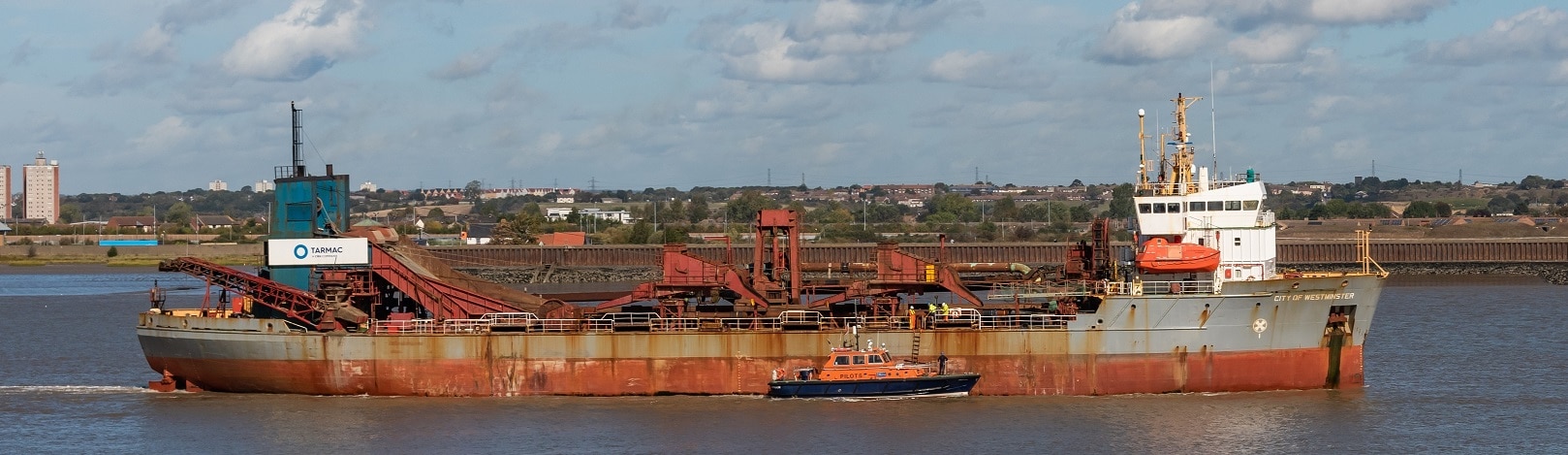
Final Call to Complete the SMI Mas Survey
The Society of Maritime Industries is undertaking this short survey to ascertain the scope and size of Maritime Autonomous Systems (MAS) for UK business.
The aggregated data will be used by the MAS Council in SMI to engage with government stakeholders to demonstrate the economic importance of MAS to the UK and to develop business opportunities for UK enterprises in this sector.
Please complete the survey by 18th December to support the industry:
https://www.surveymonkey.co.uk/r/LPCCKB3
For more information visit: www.maritimeindustries.org

DLM 3D Prints Safety Release for Drone-Lifted Dipping Sonars
Dynamic Load Monitoring (UK) Ltd (DLM), of Southampton, UK has 3D printed a fully-functioning prototype safety release mechanism for dipping sonars manufactured by Thurn Group Ltd. The product, which is approx. 211mm high and 85mm in diameter, weighs just 466 grams.
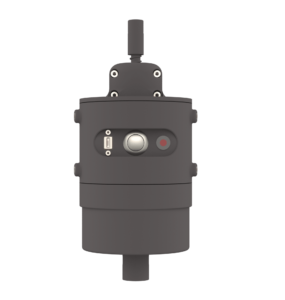 Thurn, a Norwich, UK-based manufacturer of underwater survey technology, is launching a new range of dipping sonars carried by roto-copter drones. The target market for Thurn’s innovative products are customers that are required to navigate and survey inaccessible and dangerous waterways where hidden sunken tangle hazards maybe present. The dipping sonars drag sensors through the water on a predefined route, autonomously. DLM’s attachment, which was delivered in one piece, will be fixed to the underside of the drone.
Dr. T.M. Hiller, General Manager (and founder) at Thurn Group Ltd., said: “We are hoping to supply these worldwide with dipping sonars, to many different customers and industries. This is an enabling technology that will allow safer drone operations over water wherever dipping sonars are employed, significantly reducing the risk of losing the drone. We looked at other suppliers too, but DLM’s solution was up to specification and we are looking forward to using it.”
The release can be activated in three ways: via a pull of a certain force for a length of time, for example, 2kg for four seconds; via a 3.3V signal from the drone triggered manually on the drone’s handheld controller; or via a 3.3V signal from the drone triggered by the drone control software. The drone software can be programmed to look for errors in flight behaviour, such as the payload swinging too much. The operator that is watching the drone, meanwhile, can look out for problems the software does not see. In all instances, the drone can return safely and the waterproof sonar picked up later utilising a tracking signal.
Field testing
Hiller confirmed that field tests will begin “within weeks”. The final product may also be 3D printed. DLM has not immediately designed other sizes, but the product facilitates simple change of the load spring to suit different load applications. This means that if a stronger spring is installed in the top of the mechanism its takes more pulling force before the device will release the payload. Conversely, if a weaker spring is installed it requires a smaller pulling force to release it, which would be more suitable for smaller payloads. This can be easily done by the user in the field without having to recalibrate the device.
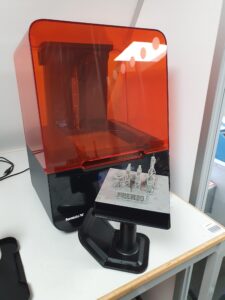
DLM’s FormLabs Form 3 3D printer, supplied by Solid Print3D Ltd., of Warwickshire, UK utilises a technology called Stereolithography (SLA), which, as James Pawsey, Mechanical Design Engineer at DLM, explained, is a more costly but more accurate method of 3D printing versus “more typical” fuse deposition modelling (FDM). Pawsey said: “FDM uses a thread of plastic that gets melted and built up in layers; SLA uses an ultraviolet laser to cure liquid resin layer by layer. It’s an interesting technological development that we’re keen to leverage.”
A 3D-printed solution aligned with Thurn’s initial expectations for the release concept, and Pawsey said it was an easy decision to utilise the machine that has been part of DLM’s printing fleet since August, from when it has been in almost constant use.
He said: “[Thurn] needed it to be lightweight and produced on a budget in a short timeframe. None of these things lend themselves too well to traditional machining or moulding techniques. We were able to print some parts on the same day as designing them, try them out and modify the design, which we really could not have done without it.”
DLM loosely based the safety release mechanism on larger, heavier products used in the cable laying industry, but they would not be suitable to use with a flying drone.
For more information visit: www.dlm-uk.com